You pop a mint into your mouth because you want one thing fast: freshness. But then a question hits. What actually creates that cool, clean feeling? Many people assume mints are just sugar with flavoring. Others think peppermint alone does all the work. I understand the confusion. In my work with mint candy copywriting, I’ve learned that one small tablet can carry a surprisingly smart formula. Once we understand the main ingredient, choosing better mints becomes much easier.
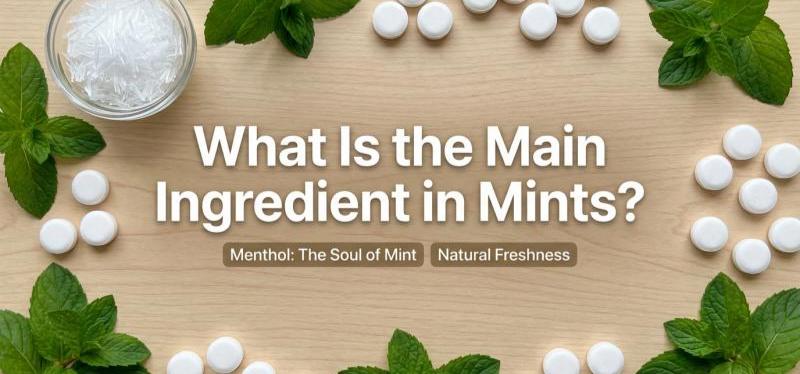
The main ingredient responsible for the classic minty cooling sensation is menthol. Menthol is a naturally occurring compound found in mint plants, especially peppermint and spearmint. In many mint candies, the largest ingredient by weight may be sugar or a sugar-free sweetener. But when we talk about the ingredient that makes a mint feel like a mint, menthol is the key. It creates the cool, refreshing feeling we expect from mints.
That difference matters.
A mint is not only about sweetness.
It is about sensation, aroma, freshness, and balance.
As Suifa, I always look at mints through that lens.
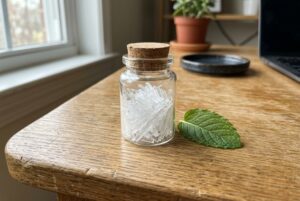
What Is Menthol?
Menthol is an organic compound known for its cooling effect, minty aroma, and fresh taste. It can come from natural mint oils, or it can be produced synthetically for consistent quality and supply.
According to PubChem’s menthol profile, menthol is a compound associated with mint oils and is widely used in flavoring and fragrance applications. That matches what I see in mint candy development. Menthol is small in quantity, but huge in impact.
It does not actually lower the temperature inside your mouth.
Instead, menthol activates cold-sensitive receptors, which makes your mouth feel cool even when nothing is truly colder.
That is why one tiny mint can feel icy.
That is also why some mints feel gentle, while others feel almost sharp.
The difference often comes down to the amount of menthol and the way it is blended with sweeteners and other flavor notes.
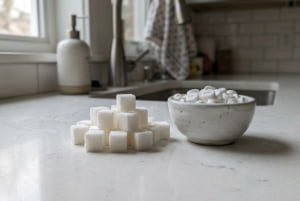
Is Menthol Always the Biggest Ingredient in Mints?
This is where I like to be precise.
If we are talking about flavor identity, menthol is the main ingredient.
But if we are talking about weight, many mints contain more sugar, sorbitol, xylitol, or other sweeteners than menthol.
That is normal.
Menthol is powerful. A little goes a long way.
A mint candy needs structure. It needs sweetness. It needs texture. It needs to dissolve in a pleasant way.
So the formula usually includes a base ingredient, a cooling ingredient, and support ingredients.
Here is a simple table I use when explaining this to clients.
| Ingredient Type | Common Examples | Main Purpose in Mints |
| Cooling ingredient | Menthol, peppermint oil, spearmint oil | Creates the fresh, cool mint sensation |
| Sweetener base | Sugar, xylitol, sorbitol, isomalt | Adds sweetness and body |
| Binder or filler | Maltodextrin, gum arabic, magnesium stearate | Helps the mint hold shape |
| Flavor support | Natural flavors, artificial flavors | Rounds out the mint profile |
| Color or polish | Glazing agents, natural colors | Improves appearance and finish |
So, when someone asks me, “What is the main ingredient in mints?” I answer carefully.
For the cooling mint effect, it is menthol.
For the candy structure, it is often sugar or a sugar-free sweetener.
Both answers are useful.
But menthol is the soul of the mint.
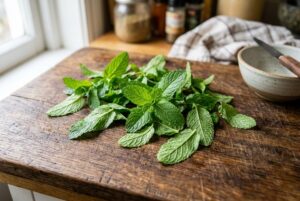
Where Does Menthol Come From?
Menthol is commonly associated with peppermint and spearmint.
Peppermint oil naturally contains menthol, which gives peppermint its strong cooling profile. Spearmint usually feels softer and sweeter because it has a different aromatic balance.
The Encyclopaedia Britannica page on menthol describes menthol as a compound obtained from peppermint oil or made synthetically. That is exactly what we see in modern mint production.
There are two major sources.
Natural Menthol
Natural menthol comes from mint plants.
Peppermint leaves are harvested. The oil is extracted. Then menthol can be isolated from that oil.
Natural menthol often gives a rounded, botanical feel.
I find it especially beautiful in premium mint candies.
It feels less flat.
It has depth.
It can remind us of real peppermint leaves, not just “coldness.”
Synthetic Menthol
Synthetic menthol is made through controlled production processes.
It can match natural menthol chemically.
For many brands, synthetic menthol helps with consistency. The flavor stays stable from batch to batch.
That matters in large-scale candy production.
I do not automatically see synthetic menthol as bad.
What matters is quality, balance, and transparency.
A cheap mint can taste harsh.
A well-made mint, even with synthetic menthol, can taste clean and elegant.
Why Do Mints Feel Cold?
This is one of my favorite parts.
Menthol creates a cooling sensation by interacting with cold receptors in the mouth.
It tricks the sensory system.
The mint is not freezing.
Your mouth is not suddenly colder.
But your body reads the menthol signal as coolness.
That is the magic.
This is why mints are so useful before a meeting, after coffee, or during travel.
The freshness feels immediate.
It resets the mouth.
It gives us confidence.
As a copywriter, I never describe this as just “flavor.” It is more than that.
It is an experience.
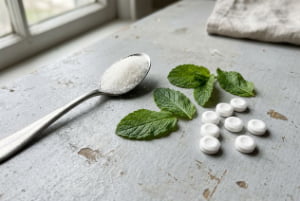
What Other Ingredients Are Found in Mints?
A mint candy may look simple, but the formula is carefully built.
Let’s look at the most common supporting ingredients.
Sweeteners
Most mints need sweetness to balance menthol.
Without sweetness, menthol can taste bitter, medicinal, or too sharp.
Traditional mints often use sugar.
Sugar-free mints may use sugar alcohols such as xylitol, sorbitol, or isomalt.
Here is a helpful comparison.
| Sweetener | Common Use in Mints | Taste and Texture Notes |
| Sugar | Classic hard mints and soft mints | Sweet, familiar, smooth finish |
| Xylitol | Sugar-free breath mints | Clean sweetness; often linked with oral-care products |
| Sorbitol | Sugar-free tablets and compressed mints | Mild sweetness; smooth texture |
| Isomalt | Sugar-free hard candies | Stable, glassy texture; less sticky |
| Aspartame or sucralose | Low-calorie mints | Strong sweetness in tiny amounts |
I personally pay close attention to sweeteners.
They change the whole personality of a mint.
A sugar mint can feel nostalgic.
A xylitol mint can feel modern and oral-care focused.
An isomalt mint can feel clean and long-lasting.
Binders and Fillers
Binders help mints stay solid and consistent.
Compressed mints especially need these ingredients.
They prevent crumbling.
They help the mint dissolve at the right speed.
They also help manufacturers create a neat shape.
Common binders and processing aids may include maltodextrin, gum arabic, or magnesium stearate.
These ingredients are not usually the star of the label.
But they matter.
A mint that cracks too quickly feels cheap.
A mint that melts too slowly can feel chalky.
Texture is part of the promise.
Flavorings
Menthol gives cooling power, but flavorings shape the final taste.
A mint may include:
- Peppermint flavor
- Spearmint flavor
- Wintergreen flavor
- Natural mint oil
- Artificial mint flavor
- Herbal or fruit notes
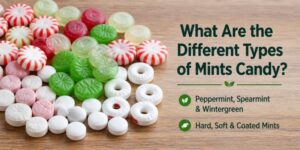
Peppermint usually feels strong and bright.
Spearmint feels smoother and sweeter.
Wintergreen feels creamy and bold.
Some brands mix them.
I love blended mint profiles because they can feel more complete.
A good mint is not just cold.
It has a beginning, middle, and finish.

Are Peppermint and Menthol the Same Thing?
No.
Peppermint is a plant. Menthol is a compound found in peppermint oil.
This is an important distinction.
Peppermint contains menthol, but it also contains other aromatic compounds. Those compounds add green, herbal, sweet, and slightly spicy notes.
That is why pure menthol can feel sharp and icy, while peppermint oil can feel fuller.
Think of it this way.
Menthol is the cooling note.
Peppermint is the whole song.
In mint candy, makers may use peppermint oil, menthol, or both.
When both are used well, the mint tastes natural and refreshing.
When only cooling is emphasized, the mint may feel strong but less flavorful.
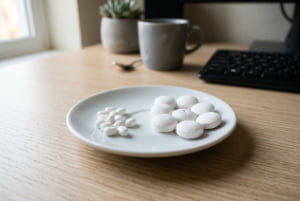
Why Do Some Mints Feel Stronger Than Others?
Some mints are made for gentle breath freshening.
Others are made to feel intense.
Stronger mints may include more menthol or additional cooling ingredients.
The texture matters too.
A fast-dissolving mint releases flavor quickly.
A hard mint releases it slowly.
A chewy mint spreads flavor differently because chewing increases contact with the mouth.
From my expert view, strength is not always better.
Balance is better.
A mint should refresh without punishing the tongue.

Are Sugar-Free Mints Better?
Not always.
But they can be a smart choice.
Sugar-free mints are popular because they offer freshness without added sugar. Many also fit better into oral-care positioning.
Some sugar-free mints use xylitol. Xylitol is often discussed in relation to dental health, and the American Dental Association’s oral health topic on chewing gum explains how sugar-free gum can help stimulate saliva flow, which supports oral cleanliness.
That said, mints are still candies or breath fresheners.
They are not a replacement for brushing, flossing, or dental care.
I always remind readers of that.
A mint can help you feel fresh.
It cannot do the whole job alone.
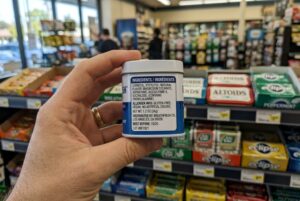
How Should We Read a Mint Ingredient Label?
I like to read mint labels from two angles.
First, I look for the cooling source.
Second, I look for the sweetener base.
Here is my simple checklist.
- Does it use menthol, peppermint oil, or spearmint oil?
- Is the mint sugar-based or sugar-free?
- What sweetener is used?
- Does it list natural flavors or artificial flavors?
- Does the texture match the promise: hard, soft, chewy, or compressed?
- Are there extra claims, such as oral-care support or long-lasting freshness?
If a brand says “extra strong,” I expect a clear menthol hit.
If it says “natural peppermint,” I expect a botanical taste.
If it says “sugar-free,” I look for sweeteners like xylitol, sorbitol, or isomalt.
Good labeling builds trust.
Vague labeling makes me cautious.
What Makes a Good Mint Candy?
A good mint has harmony.
The best mints balance cooling, sweetness, texture, and aftertaste.
Too much menthol can feel medicinal.
Too much sugar can feel sticky.
Too much artificial flavor can feel flat.
Too little flavor can feel disappointing.
When I evaluate a mint, I ask myself:
- Does the first taste feel clean?
- Does the cooling arrive quickly?
- Is the sweetness pleasant?
- Does the mint dissolve smoothly?
- Is the aftertaste fresh or chemical?
- Would I reach for another one?
That last question matters most.
A great mint makes us want to repeat the experience.
What Is the Real Answer?
The real answer depends on what we mean by “main.”
If we mean the ingredient that defines the mint experience, the answer is clear.
Menthol is the main ingredient responsible for the minty cooling sensation.
If we mean the ingredient used in the largest amount, the answer may be different.
It may be sugar.
It may be xylitol.
It may be sorbitol.
But without menthol or mint oil, the candy loses its identity.
It becomes just a sweet tablet.
That is why I call menthol the heart of mints.
It carries the freshness.
It creates the coolness.
It gives the candy its purpose.
More Related Questions
Do all mints contain menthol?
Not always. Some may rely mostly on mint flavorings or other cooling agents. But most classic mint candies use menthol, peppermint oil, spearmint oil, or a related mint flavor system.
Is menthol natural?
It can be. Menthol can come naturally from mint oils, or it can be made synthetically. Both forms can create a cooling effect.
Are mints candy or breath fresheners?
They can be both. Many mints are candy products designed for breath freshening. The formula decides the focus.
What is the difference between peppermint and spearmint?
Peppermint is usually stronger and cooler. Spearmint is usually sweeter and softer. Peppermint often has more menthol character, while spearmint feels rounder.
Can mints replace brushing?
No. Mints can help freshen breath temporarily. They do not replace brushing, flossing, or regular dental care.
Conclusion
The main cooling ingredient in mints is menthol. It gives mints their fresh, icy character. Sugar or sweeteners often form the base, but menthol creates the identity. When we understand that, we choose mints with more confidence and better taste.