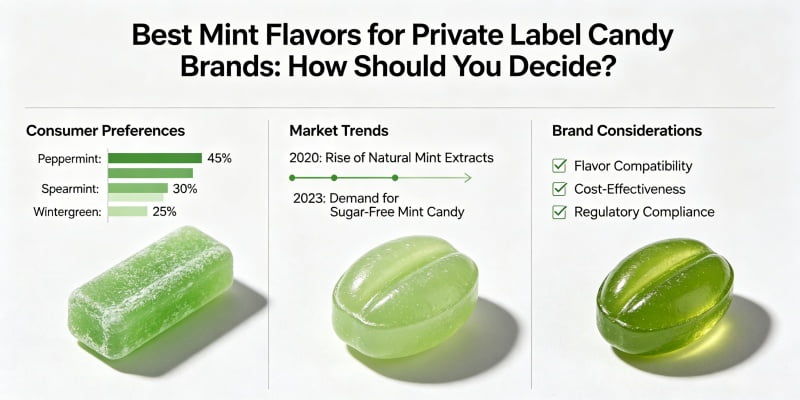
Choosing a mint flavor for your new private label brand can feel overwhelming. A wrong choice could lead to slow sales, but the "best" flavor is about smart selection.
The best mint flavor for a private label brand is one that matches your target market, brand positioning, and risk tolerance. For a safe start, classic cool mint or spearmint are excellent choices due to their broad appeal1, providing a solid foundation before introducing more adventurous options.
Over my 28 years in candy manufacturing, I've seen countless brand owners grapple with this decision. It's easy to get lost in a sea of flavor options. But the most successful brands don't just pick a flavor they like. They choose a flavor that fits a clear strategy. The real question isn't "what's the most popular mint?" but "what mint flavor will best serve my brand's goals?" Let's break down how to think about this decision like a seasoned brand manager.
Should You Start with a Classic Mint Flavor for a New Brand?
You want to launch your first mint candy but fear picking a flavor that won't sell. Niche flavors feel risky, but is a classic flavor too boring to stand out?
Yes, starting with a classic flavor like peppermint or spearmint is often the safest strategy for a new private label brand. These flavors have wide consumer acceptance, providing a solid foundation for your product line before you introduce more differentiated options and reducing your initial market risk.
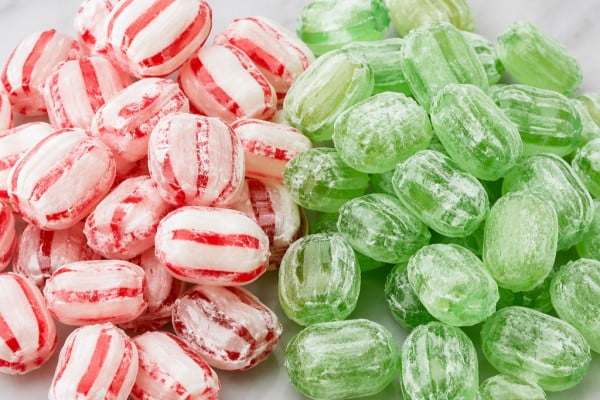
In my experience helping clients develop their first private label candies, the conversation almost always begins with classic flavors. There's a very good reason for this. Launching a new product is already a risk, so you want to control as many variables as possible. A familiar flavor like peppermint (often called "cool mint") or spearmint removes the barrier of consumer uncertainty. People know what to expect, making the purchase decision easier.2
This approach allows you to establish a market foothold. Once you have a customer base that trusts your brand's quality with a classic flavor, you have earned the right to introduce something more unique. Think of it as building a house; you need a solid, reliable foundation before you can add interesting architectural details. The same logic applies to building a product line.
Peppermint vs. Spearmint: Your First Strategic Choice
Even within the "classic" category, you have a strategic choice to make. Peppermint and spearmint appeal to different consumer preferences and usage occasions.3 This is often the first real decision a brand owner makes in defining their brand's identity.
| Feature | Peppermint (Cool Mint) | Spearmint |
|---|---|---|
| Flavor Profile | Strong, sharp, intense cooling sensation | Mild, sweet, slightly herbal and smooth |
| Primary Use Case | Powerful breath freshening, post-meal, a "pick-me-up" | Everyday enjoyment, all-day candy, gentle refreshment |
| Market Risk | Low | Very Low |
| Brand Positioning | Functional, classic, bold, adult-oriented | Gentle, natural, family-friendly, approachable |
Choosing between these two isn't just about taste; it's about signaling your brand's intent. Are you a powerful solution for bad breath, or a pleasant, everyday treat? Answering that question will guide your first flavor choice.
When Should You Choose a Strong or Icy Mint Flavor?
Your brand needs to stand out from a sea of standard mints. A weak mint won't get noticed, but an overly strong one might alienate potential customers.
You should choose a strong or icy mint flavor when your brand targets a specific niche, such as adults seeking intense breath freshening or a sensory "kick."4 These powerful profiles create a memorable experience but require a clear understanding of your target audience and are best for functional positioning.
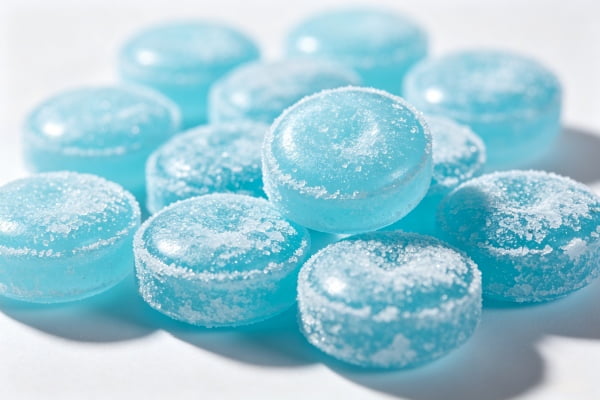
A stronger mint can be a powerful differentiator, but it's a positioning tool, not an automatic upgrade. In our OEM projects, requests for "extra-strong" or "icy" mints almost always come from brands with a very specific customer in mind. They aren't trying to appeal to everyone. They are targeting consumers who need a solution: a post-coffee breath reset, a way to stay alert during a late-night drive, or just a powerful sensory experience.
The key here is that "strength" is subjective and needs to be tested. What one market considers "strong," another might find overwhelming. This is where customization becomes critical. As a manufacturer, we don't just offer one "strong mint." We discuss adjusting the level of the cooling agent, typically menthol, to achieve a precise intensity5. This ensures the product is impactful without being unpleasant for the intended consumer.
Balancing Intensity and Appeal
I always advise clients to move beyond the flavor name and focus on the desired effect. The term "Arctic Blast" on a package sets an expectation for an intense cooling sensation. Your product must deliver on that promise. We achieve this by carefully formulating the recipe. A small change in the percentage of the cooling agent can make a huge difference.6 That's why sampling is a non-negotiable step in the development process. You need to taste different levels of intensity to find the perfect balance that excites your target demographic without driving away repeat purchases. A mint that is too strong might be tried once for novelty but won't become a daily habit.7
Are Fruit-Mint or Herbal-Mint Flavors a Good Idea?
You want to offer something innovative in the mint category. But what if your unique lemon-mint or chamomile-mint flavor just sits on the shelf collecting dust?
Fruit-mint or herbal-mint flavors are a great idea for expanding an existing product line or for brands targeting health-conscious or adventurous consumers.8 Flavors like lemon-mint or ginger-mint create a unique selling proposition but are generally riskier for a brand's very first product launch.
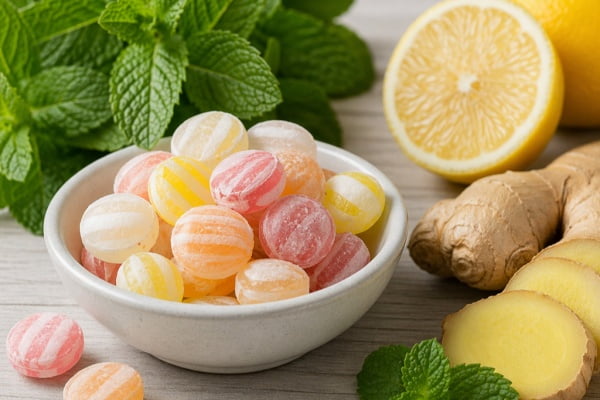
Combination flavors are where your brand can truly start to innovate, but they work best as a second step. After you've built trust with a core product, you can introduce a "line extension" to capture new customers or encourage existing ones to try something different. These flavors tap into broader consumer trends. For example, citrus-mint combinations play into the demand for zesty refreshment, while herbal-mints like chamomile-mint or ginger-mint appeal to the wellness market9.
Before committing to a full production run of a novel flavor, however, market validation is essential10. From my experience, the most successful launches in this category are backed by research or at least small-scale testing. When a client wants to develop a berry-mint flavor, I ask them, "Who is this for? Is it for kids? Is it a summer special?" The answers help us customize the flavor profile to be more sweet or more mint-forward, ensuring it aligns with their strategy.
Positioning with Combination Flavors
Different combinations send very different signals to the consumer. This isn't just about adding a second flavor; it's about creating a new product concept. A well-chosen combination can carve out a very specific and defensible niche in the market.
| Combination Flavor | Target Position | Best For... |
|---|---|---|
| Lemon-Mint / Orange-Mint | Refreshing, Zesty, Bright | Summer promotions, younger audiences, daytime use |
| Berry-Mint / Cherry-Mint | Sweet, Playful, Familiar | Family-oriented brands, traditional candy aisles |
| Ginger-Mint / Turmeric-Mint | Warming, Soothing, Wellness | Functional food sections, health-conscious consumers |
| Eucalyptus-Mint / Tea-Mint | Therapeutic, Calming, Natural | Cold season products, premium/natural food stores |
This strategic thinking transforms a simple flavor choice into a powerful branding tool. It shows you understand your customer's lifestyle and needs beyond just wanting a mint.
How Does Packaging and Price Affect Your Flavor Choice?
You've picked a great flavor, but haven't considered the full product experience. The perfect flavor can fail if its packaging and price send a conflicting message to the consumer.
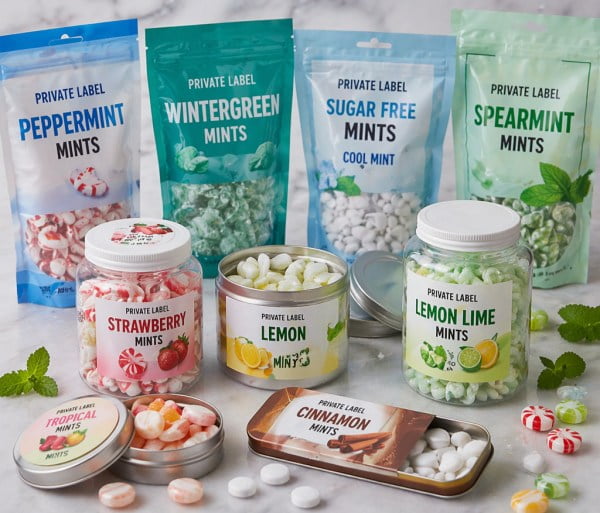
Your flavor choice is directly linked to packaging and price. A premium, complex flavor like lavender-mint works best in high-end packaging like a tin with a higher price point. A simple, classic cool mint is more suitable for a low-cost roll pack for impulse buys.
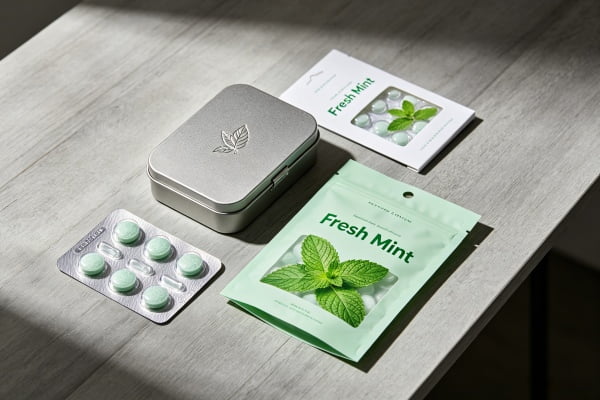
This is one of the most overlooked aspects of product development, but it's absolutely critical. The flavor, packaging, and price must work together to tell a single, coherent story about your product.11 A mismatch here will confuse the customer and hurt sales. When I work with a private label brand, our conversation is never just about flavor in isolation. We discuss the entire product concept to ensure every element is aligned.
Imagine you see a beautifully designed, expensive metal tin of mints. You expect a sophisticated, unique flavor inside, perhaps an herbal-mint or a subtle fruit infusion. If you open it and find a very basic, sugary peppermint, you'll feel disappointed. The product didn't live up to the promise of its packaging. Conversely, a complex, expensive-to-produce flavor sold in a cheap plastic wrapper for 99 cents will likely fail because the price and packaging devalue the product inside.
Creating a Cohesive Product Strategy
The key is to define your product's place in the market first, and then let that guide your decisions on flavor, packaging, and price. Here are a few common scenarios I discuss with brand owners:
-
Mass Market Impulse Buy: The goal is high volume at a low price point, often sold at checkout counters.
- Flavor: Classic Cool Mint or Spearmint. Broad appeal is key.
- Packaging: Inexpensive flow wrap, blister pack, or roll wrap.
- Price: Low.
-
Premium Boutique Gift: The goal is to create a high-margin, desirable item sold in specialty stores or online.
- Flavor: Unique and sophisticated, like Rose-Mint, Ginger-Mint, or a custom herbal blend.
- Packaging: High-quality metal tin or beautifully designed box.
- Price: High.
-
Functional Breath Freshener: The goal is to solve a specific problem for the consumer.
- Flavor: Extra-Strong Icy Mint. The flavor must communicate effectiveness.
- Packaging: Functional and portable, like a slide tin or a durable blister card.
- Price: Mid-to-High.
Thinking through these scenarios helps you build a product with a clear identity. It ensures that when a customer sees your product on the shelf, everything about it—from the name to the taste—makes perfect sense.
Conclusion
Choosing the best mint flavor is a strategic decision, not a guess. It requires balancing market safety with brand positioning and aligning your choice with the product's format, packaging, and price.
"Mint (candy) - Wikipedia", https://en.wikipedia.org/wiki/Mint_(candy). A source documenting the widespread use or consumer familiarity of peppermint and spearmint in confectionery or breath-freshening products would support the article’s claim that these classic mint profiles have broad appeal; such evidence would contextualize market safety rather than prove performance for a specific private-label launch. Evidence role: general_support; source type: research. Supports: A neutral source should show that peppermint and spearmint are widely used or commonly preferred mint flavor profiles in food, confectionery, oral-care, or breath-freshening products.. Scope note: Contextual support would not directly establish sales outcomes for the author’s specific product category or target market. ↩
"The Effect of Decision Fatigue on Food Choices: A Narrative Review", https://pmc.ncbi.nlm.nih.gov/articles/PMC12736114/. A study on food familiarity and consumer expectations would support the statement that known flavors can simplify choice by giving consumers a clearer expectation of the product experience; the support is behavioral and not specific to mint confectionery. Evidence role: mechanism; source type: paper. Supports: A scholarly source should explain how familiarity and prior expectations influence food choice or purchase intention.. Scope note: The source may not test peppermint or spearmint candies directly. ↩
"Differences in “minty” flavor compound and synthetic cooling agent ...", https://pmc.ncbi.nlm.nih.gov/articles/PMC12776481/. A source describing the chemical and sensory differences between peppermint and spearmint would support the article’s distinction between their flavor profiles; it would not by itself verify the proposed marketing occasions assigned to each flavor. Evidence role: definition; source type: education. Supports: A university, encyclopedia, or food-science source should explain that peppermint and spearmint differ chemically and sensorially, for example in menthol and carvone content.. Scope note: Chemical profile evidence supports flavor differentiation but not the article’s specific branding recommendations. ↩
"Evaluation of the use of a peppermint mouth rinse for halitosis ... - PMC", https://pmc.ncbi.nlm.nih.gov/articles/PMC3894100/. Research on menthol cooling perception or mint-flavored breath-freshening products would support the claim that intense mint profiles can create a strong sensory freshness cue, though it would not prove that adults are the only or primary target group. Evidence role: general_support; source type: paper. Supports: A neutral source should support that mentholated or mint-flavored products are associated with cooling sensation and perceived breath freshness.. Scope note: The evidence would support sensory association more directly than demographic targeting. ↩
"Sweet-enhancing effect of coolant agent menthol evaluated via ...", https://pmc.ncbi.nlm.nih.gov/articles/PMC11930197/. Scientific literature on menthol and cold-receptor activation supports the statement that menthol produces a cooling sensation and can be used to modulate perceived mint intensity in formulated products. Evidence role: mechanism; source type: paper. Supports: A scientific source should explain that menthol activates cold-sensitive receptors and produces a cooling sensation, supporting its role as a controllable cooling agent.. ↩
"Sweet-enhancing effect of coolant agent menthol evaluated via ...", https://pmc.ncbi.nlm.nih.gov/articles/PMC11930197/. A dose-response sensory study of menthol or related cooling agents would support the claim that relatively small concentration changes can noticeably affect perceived cooling intensity; applicability may vary by candy matrix and formulation. Evidence role: mechanism; source type: paper. Supports: A sensory evaluation or psychophysics study should show that perceived cooling intensity varies with menthol or cooling-agent concentration.. Scope note: Results from model systems or oral-care products may not transfer exactly to hard candy formulations. ↩
"Sensory Features, Liking and Emotions of Consumers towards ...", https://pmc.ncbi.nlm.nih.gov/articles/PMC7826582/. Consumer sensory research on optimal flavor intensity would support the article’s warning that overly intense mint products may reduce repeat acceptance, although it would not directly demonstrate one-time trial behavior for a specific mint candy. Evidence role: mechanism; source type: paper. Supports: A consumer sensory study should support the general principle that liking often depends on an optimal level of sensory intensity and that excessive intensity can reduce acceptance.. Scope note: The source would likely address liking or acceptance rather than actual long-term purchasing habits. ↩
"Flavor and Well‐Being: A Comprehensive Review of Food Choices ...", https://pmc.ncbi.nlm.nih.gov/articles/PMC12082435/. Research on consumer innovativeness, variety seeking, or flavor line extensions would support the claim that fruit-mint and herbal-mint combinations may suit expansion strategies and novelty-oriented segments; it would not prove demand for any particular combination such as lemon-mint or ginger-mint. Evidence role: general_support; source type: paper. Supports: A scholarly or institutional source should support that novelty-seeking consumers are more receptive to unusual flavors and that flavor variety can be used in product-line extensions.. Scope note: The evidence would be segment-level and strategy-level rather than direct sales evidence for specific flavors. ↩
"Functional Foods Enriched With Bioactive Compounds - PMC - NIH", https://pmc.ncbi.nlm.nih.gov/articles/PMC12501769/. Research on consumer perceptions of herbal ingredients in foods and beverages would support the article’s claim that chamomile- or ginger-based mint combinations can signal wellness positioning, while not establishing therapeutic efficacy for the candy itself. Evidence role: general_support; source type: paper. Supports: A source should support that consumers often associate herbal ingredients such as chamomile or ginger with health, wellness, or functional-food cues.. Scope note: The source should not be used to imply medical benefits unless it directly studies those outcomes. ↩
"Food Product Development - K-State Extension", https://extension.k-state.edu/kvafl/resources/development.html. Food product development literature supports the use of consumer testing, concept testing, or small-scale market validation before commercial launch, especially for novel products; this supports the process recommendation rather than guaranteeing launch success. Evidence role: expert_consensus; source type: education. Supports: A food product development textbook, university extension source, or peer-reviewed article should support the role of consumer testing and market validation before launch.. Scope note: Validation methods reduce uncertainty but do not eliminate commercial risk. ↩
"Influence of food packaging color and foods type on consumer ...", https://pmc.ncbi.nlm.nih.gov/articles/PMC10832432/. Marketing and consumer-behavior research on extrinsic product cues supports the claim that packaging, price, and sensory expectations should be consistent because consumers use these cues jointly to infer quality and product positioning. Evidence role: mechanism; source type: paper. Supports: A consumer behavior or marketing study should show that packaging and price act as extrinsic cues that shape expectations, perceived quality, or willingness to buy.. ↩